Off-the-shelf ERP or custom ERP?
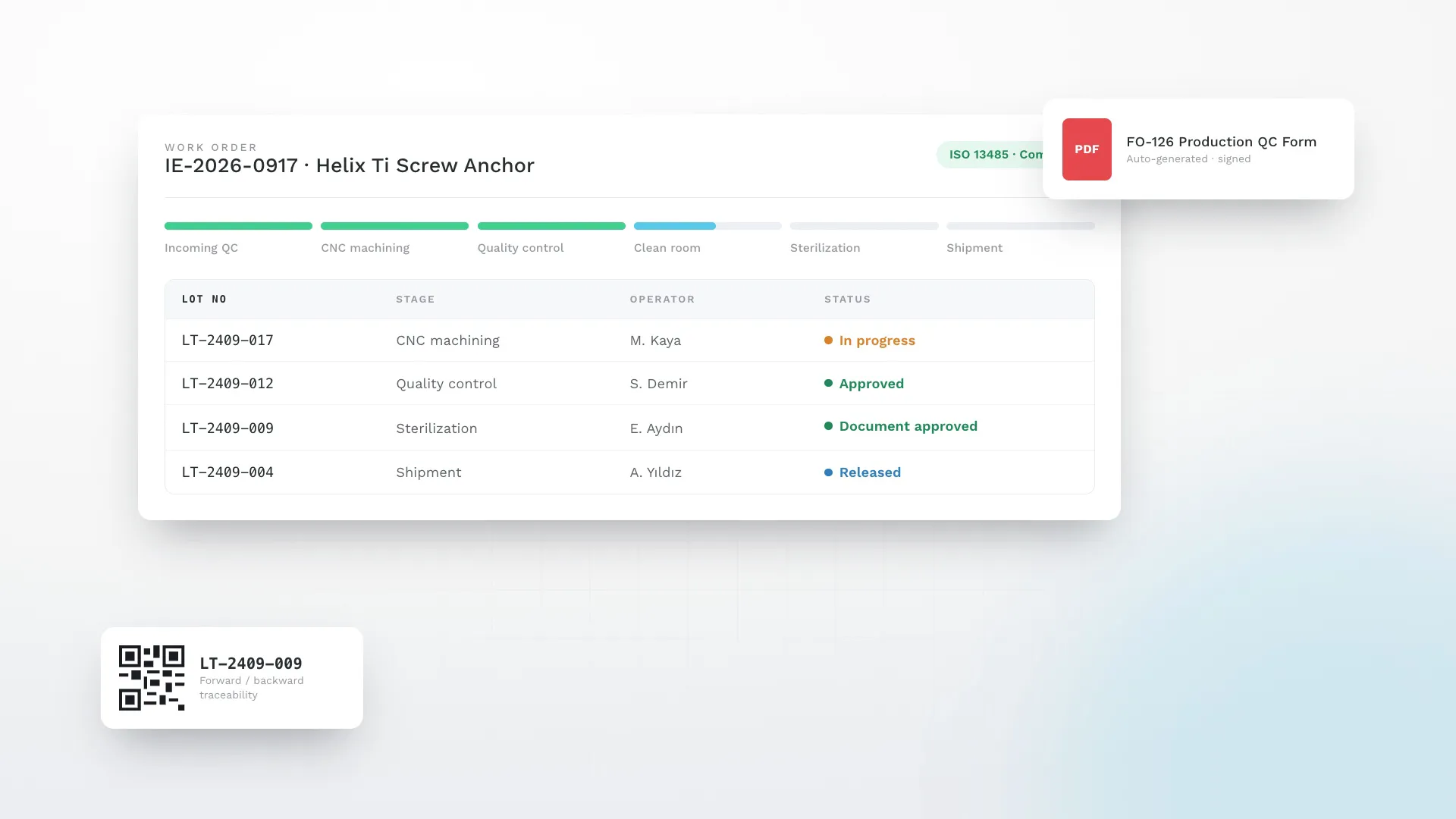
For businesses with standard processes that can adapt to a package's workflow, off-the-shelf ERP is usually faster and cheaper. For businesses with industry-specific forms, audit requirements (such as ISO 13485 traceability) or approval steps packages don't cover, custom ERP is more efficient because it runs only the modules you need, in your business's own language.
- Standard processes → off-the-shelf ERP
- Industry-specific forms and audits → custom ERP
- Hybrid: packaged accounting, custom operations
- Either way, start with an MVP
The short answer: look at fit
The most common mistake in choosing an ERP is comparing feature lists. The real question is: will the system fit the way we work, or will we have to fit the way the system works? The second isn't always bad; sometimes a package's standard process is better than a company's current habits.
Comparison table
| Criterion | Off-the-shelf ERP | Custom ERP |
|---|---|---|
| Time to start | Short (setup + configuration) | Longer (analysis + development) |
| Upfront cost | Usually lower, licence-based | Development fee |
| Long-term cost | Per-user licences, module fees | Maintenance and development |
| Process fit | You adapt to the package | Fits the process one-to-one |
| Industry-specific forms | Limited / extra development | Exact digital counterparts |
| Flexibility | As far as the package allows | Grows with your needs |
| User habits | A new interface to learn | Familiar logic can be kept |
When is off-the-shelf ERP the right choice?
- When your processes are the same as many businesses in your industry (standard trade, accounting, stock).
- When you have no special audit or traceability requirements.
- When your team is ready to adapt to the package's workflow.
- When starting quickly and relying on a known product is the priority.
When is custom ERP the right choice?
- When you have industry-specific forms (e.g. production QC, non-conformity, sterilisation records).
- When forward and backward traceability by lot or serial number is mandatory.
- When the process must technically stop if a document is missing.
- When customising a package has started costing more than the package itself.
- When staff want to keep their spreadsheet habits and packaged interfaces create resistance.
The hybrid model: the smartest option for most
For many businesses the best result comes from using packaged software where regulations change often — accounting and official payroll — while building custom software for what's unique to the business, such as production, quality, traceability and field operations, and integrating the two.
How to start
- Gather the forms. Put all your paper and spreadsheet forms in one folder.
- Pick the process that wastes the most time. Usually production and quality records, or staff and payroll tracking.
- Start with an MVP. Ship a small version that proves value in one process, then plan the rest with data.
- Run in parallel. Use the old and new systems side by side for a short transition.
That's the path we followed on the medical manufacturing ERP we built: first we reviewed the company's real forms one by one and wrote a 30-section product document, then built from the most critical flow outwards.
Frequently asked questions
Is custom ERP very expensive?
The initial investment is usually higher, but since you don't pay per-user licences and only build the modules you use, the long-term comparison can look different. Decide on five-year total cost.
Who maintains a custom ERP?
The team that built it — or your own team, since the source code is handed over to you. A monthly maintenance agreement is the most common model.
Will it work with our accounting software?
Data can be exchanged with accounting software that offers an API; that's the basis of the hybrid model.